






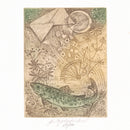
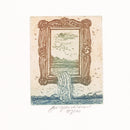
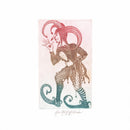








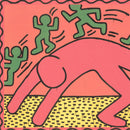









Graphic print 50x70 cm in a limited edition. Print No. 35/300. Blind embossing stamp DONALD ART CO. 1962. Loose leaf. Paper FABRIANO Cotton 300 GR. License: Museo d´Orsay
About the Author:
Edgar Degas (1834–1917) was a French painter who was considered an Impressionist, though he never regarded himself as such, despite being one of the main initiators of Impressionist exhibitions. He stood apart from this movement and was reluctant to accept the term "Impressionism" at all.
Like his colleague Édouard Manet, Degas resisted associating with the other members of the group, as his refined drawing style set him apart. He said that painting required a bit of mystery, vagueness, and fantasy. When you express your meaning too clearly, you end up boring people.
Born on July 19, 1834, in Paris, he studied under Louis Lamothe, a former pupil of the Neoclassical painter Jean-Auguste-Dominique Ingres at the Academy of Fine Arts.
His early works, imbued with academic techniques, often featured ancient themes. After the Franco-Prussian War, Edgar Degas traveled to the United States, where he painted his famous work A Cotton Office in New Orleans in 1875. In the late 1870s, Degas experienced a period of profound creativity, producing great works in sculpture, printmaking, and painting despite his deteriorating eyesight.
For the remainder of his career, he increasingly used pastels, which allowed him to work more quickly and with greater dexterity. Degas died on September 27, 1917, in Paris, France. Today, his works are part of the collections of the Hermitage Museum in St. Petersburg, the Musée d'Orsay in Paris, the Metropolitan Museum of Art in New York, and the National Gallery in London.
