












FERNAND LÉGER
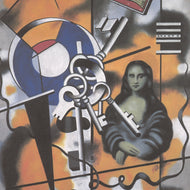
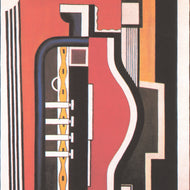
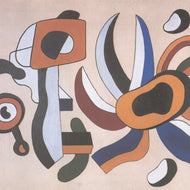
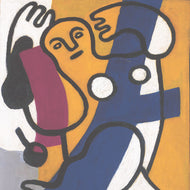
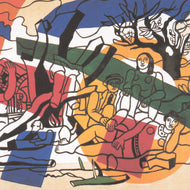
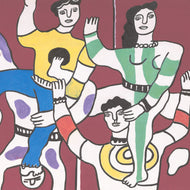
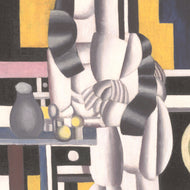
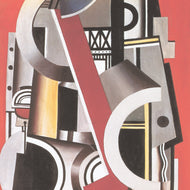
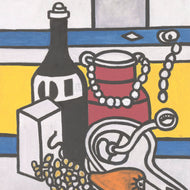
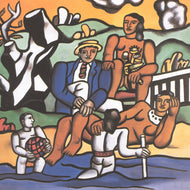
Fernand Léger (1881–1955) was a versatile French artist – a painter, sculptor, graphic artist, decorator, filmmaker, and art theoretician. From his initial period in the style of Cubism, he gradually developed his own distinctive expression, which bears strong primitivist features with an emphasis on color and figure modeling. Together with Pablo Picasso and Georges Braque, he developed unique methods of depicting three-dimensional objects in pictorial space.
Fernand Léger was born on February 4, 1881, in Argentan, France, and studied architecture. In 1900, he moved to Paris, where he worked as an architectural draftsman. While studying at the École Nationale Supérieure des Beaux-Arts and the Académie Julian, he was influenced by Paul Cézanne, Pablo Picasso, and Georges Braque.
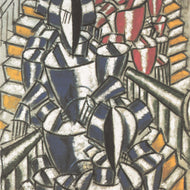
In 1905, the artist developed his characteristic style of tubular forms and mechanical imagery. He then created the avant-garde film Ballet Mécanique (1924) and designed murals for Le Corbusier's Pavillon de l'Esprit Nouveau (1925) in Paris.
By the end of World War II, Léger’s paintings became increasingly abstract, with colorful translucent planes floating amidst boldly drawn figures and objects, as seen in his work Two Women with Flowers (1954).
The artist died on August 17, 1955, in Gif-sur-Yvette, France. Today, his works are part of the collections of the Museum of Modern Art in New York, the Art Institute of Chicago, the Tate Gallery in London, the Centre Georges Pompidou in Paris, and the Albertina in Vienna.
12 products